Conservation Innovation Grant: Nitrogen Use Efficiency
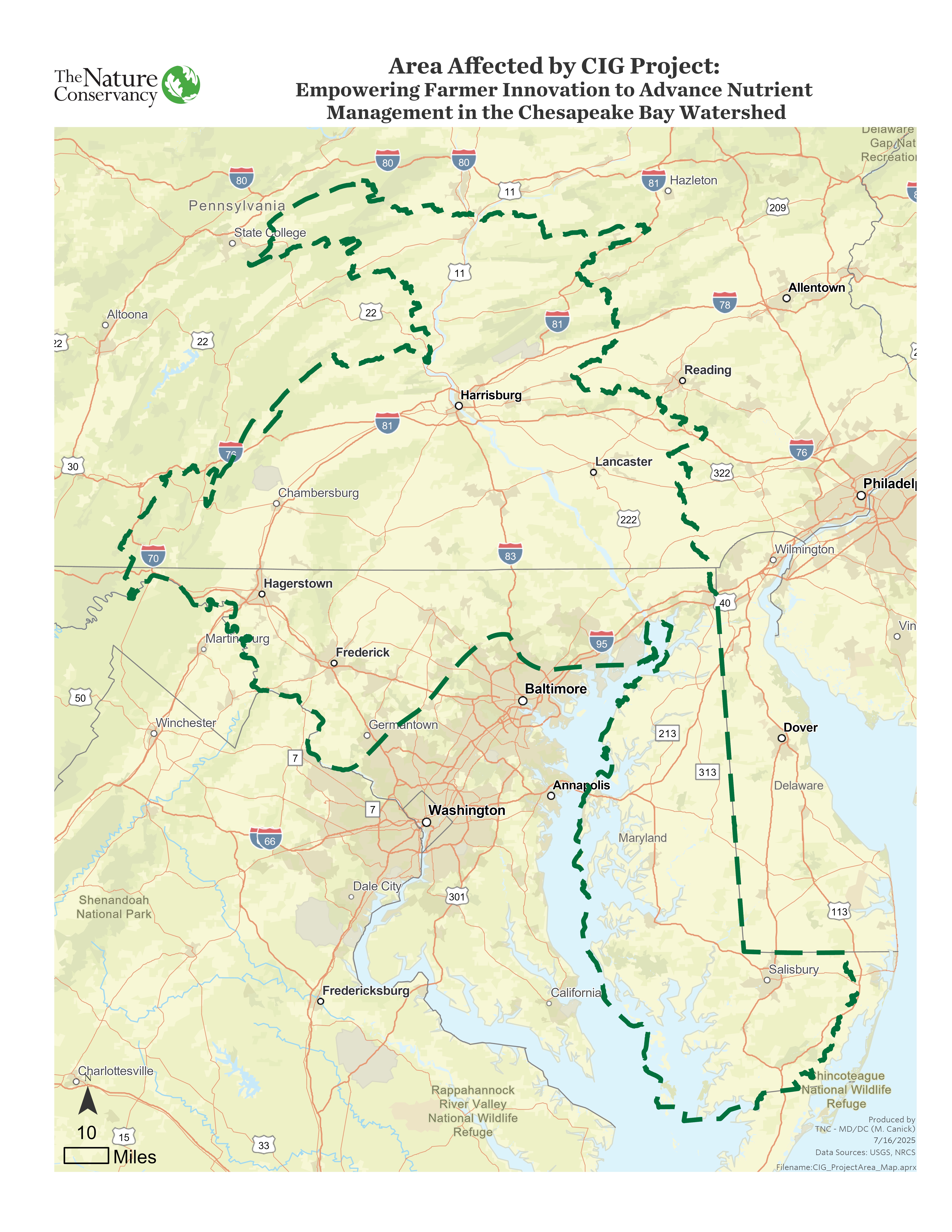
The Conservation Innovation Grant program is paying wheat and corn farmers for efficient nitrogen-use, while letting them decide how best to reach that goal. After creating a plan with trusted agribusiness advisors, farmers in Pennsylvania and Maryland will compare their existing farm management against the impact of new practices on their nitrogen use. In addition to initial payment, additional payment will be available for achieving positive results.
To see a map of the area affected by the CIG Project, select “View Resource” on the right.
Subject Tags
- Agriculture
The program is open to farmers who:
- Are located in the Maryland and Pennsylvania project area (see map below)
- Are growing corn or wheat
- Are working with or willing to work with the project’s agribusiness partners – Growmark FS, The Mill, Rosetree Consulting, and Willard Agriservice
- Meet NRCS eligibility requirements (more details below)
Farmers interested in participating or learning more, should reach out to Dr. Kristin Fisher at Kristin.fisher@tnc.org or their existing agribusiness advisors at participating agribusinesses.
Additional Program Details
Part 1: $1,000 Voucher
- Farmers will work with trusted advisors to identify ways to increase NUE in corn and/or wheat crops using a $1,000 planning voucher.
- Vouchers are flexible! Any planning that has the goal of increasing NUE in corn or wheat is eligible.
- The voucher can be used for trusted advisors to provide technical assistance, data management, equipment access, testing, etc.to help farmers to increase NUE.
- Voucher outcomes will be shared with TNC.
Part 2: NUE Payment
- Farmers will implement management practices they identify from the voucher planning work with their advisor.
- Baseline management will be compared to new management in on-farm comparisons or replicated trials.
- NUE will be calculated for implemented practices and for baseline management.
- Economic outcomes will be calculated to compare revenue changes resulting from using new practices.
- Agribusinesses will receive a data reporting payment per farm to compensate for the time necessary for site visits, and for data organization, entry, and submission.
- $500 for farms up to 200 acres
- $800 for farms 201-400 acres
Part 3: On Farm Trials
- Three farms per year from each state will be invited to participate in a comprehensive field trial using a replicated design that will be developed with support from TNC.
- A payment of $2,000 per year will be provided to farmers who participate in the replicated on-farm trials
How is this NUE calculated?
NUE will be calculated using the following formula and parameters:
Nitrogen Use Efficiency (NUE) = N removed in Harvest/N supplied
N removed in harvest will be measured by either standard published values for grain or other harvested product’s average nitrogen content or a lab test of harvested products.
N supplied will be a combination of all sources of nitrogen in manure, fertilizer, and N fixed through previous or concurrent legume crop nitrogen credits. N supplied will be based on plant available nitrogen, as recommended by the University of Maryland or the Pennsylvania State University, depending upon the location of the farm.
Historically Undeserved (HU) producers (beginning, limited resource, veteran) are eligible for a 50% bonus on Voucher and NUE payments. For any questions on HU eligibility, please reach out to Kristin Fisher at Kristin.fisher@tnc.org.
| NUE Achieved | <60% | 60-69% | 70-79% | ≥80% |
| Payment to Farmer | $15/ac | $25/ac | $35/ac | $50/ac |
Part 4: Social Evaluation
- Farmers will be interviewed twice: once following initial enrollment and once toward the end of the project.
- ‘Initial enrollment’ interviews will focus on reasons for enrollment and intended activities over the course of the project.
- ‘Post-participation’ interviews will focus on farmers’ experiences during the project, and document how and why voucher and NUE incentives contributed (or did not) to changes in on-farm activities.
- Farmers who drop out of the program for any reason will also be asked to participate in an interview. Farmer “drop-out” interviews help us understand issues with the project design and to what extent farmers intend to maintain adopted practices without project support.
- A representative from each agribusiness partner will be interviewed during the project to discuss challenges, and overall perspectives. Improvements will be made based on this input.
Enrollment Requirements
- Agribusinesses will hold agreements with TNC for Voucher payments and data reporting payments.
- Farmers will hold agreements with TNC for NUE payments and on-farm trials payments.
- Farmers must meet NRCS eligibility requirements:
- highly erodible land and wetland conservation compliance,
- have control of the land for the term of the contract,
- have an adjusted gross income under$900,000 with waivers considered by NRCS on a case-by-case basis.
- NUE payments must support a practice or approach not actively funded by another USDA program.
Questions? Contact Dr. Kristin Fisher at kristin.fisher@tnc.org
You can also read more about the program in this article from the Bay Journal.